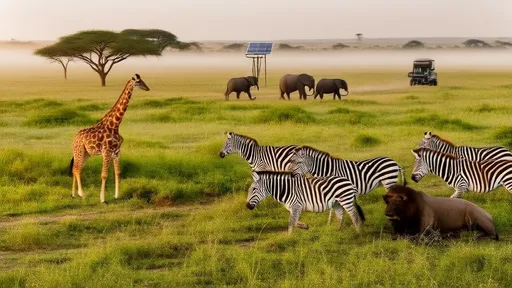
In a groundbreaking move for sustainable tourism, Africa has welcomed its first-ever zero-carbon safari experience. The newly launched reserve in Kenya’s Laikipia Plateau combines cutting-edge renewable technology with world-class wildlife viewing, offering guests the chance to track the "Big Five" in solar-powered safari vehicles. This ambitious project represents a seismic shift in how conservation and luxury tourism can coexist without compromising the environment.
The Genesis of a Green Safari Revolution
For decades, traditional safari operations have grappled with the environmental contradictions of running diesel-guzzling vehicles through pristine wilderness. The new Loisaba Conservancy partnership with eco-tourism specialists has shattered that paradigm. "We’re proving you don’t need to choose between exceptional wildlife encounters and environmental responsibility," explains conservation manager Wanjiku Kinuthia, wiping sweat from her brow as she checks the photovoltaic panels on a modified Land Cruiser. The vehicles’ roofs glint with high-efficiency solar cells capable of storing enough energy for full-day game drives across the 56,000-acre conservancy.
Morning game drives now begin without the rumble of internal combustion engines. The near-silent electric motors allow unprecedented proximity to wildlife - a herd of elephants barely lifts their trunks as vehicles approach within twenty meters. "The animals react completely differently," whispers veteran guide Joseph ole Kima, steering with one hand while adjusting his binoculars. "No engine vibration means we’re seeing natural behaviors even in thick bush country where animals would normally bolt."
Engineering Meets Ecology
Behind the scenes, German engineers worked alongside Maasai trackers to retrofit conventional safari vehicles. The conversion process involved installing 5kW solar arrays supplemented by lithium-ion battery packs with 300km range. "We’ve essentially created mobile power stations," says technical lead Dr. Felix Brandt, demonstrating the regenerative braking system that recaptures energy during descents across the rugged terrain. Each vehicle carries portable solar mats that can be unfurled during picnic stops, providing emergency charging while guests dine under acacia trees.
The infrastructure extends beyond transportation. The safari lodge itself operates on an off-grid microgrid combining solar, wind, and biogas systems. Water heating comes from thermal tubes, while innovative clay-pot coolers preserve food without refrigeration. "Every aspect had to meet our carbon calculus," notes sustainability director Amina Okeke, pointing to the reclaimed railway-sleeper furniture. Even the swimming pool uses a natural filtration system with reed beds and tilapia fish instead of chlorine.
Ripple Effects Across the Savannah
Conservationists are particularly excited about the project’s secondary benefits. Reduced noise pollution allows researchers to conduct unprecedented acoustic monitoring of animal communications. Thermal cameras powered by the solar systems have already captured never-before-seen nocturnal leopard behavior. "We’re gathering data that would’ve been impossible with diesel generators spooking the wildlife," beams research coordinator Emma Naylor, reviewing footage of a serval cat hunting at midnight.
The economic model proves equally innovative. Twenty percent of tourism revenue funds community-owned renewable energy projects in surrounding villages. Local women trained as solar technicians maintain the systems, creating what the UN has hailed as a blueprint for just energy transitions in rural Africa. "This isn’t just about saving elephants," emphasizes community liaison James Lemaina. "It’s showing how environmental tech can uplift entire ecosystems - human and animal alike."
As sunset paints the Laikipia plains gold, guests sip solar-chilled Tusker beers while watching a black rhino and her calf approach a specially designed solar-powered watering hole. The scene encapsulates the reserve’s philosophy: cutting-edge sustainability exists not as a compromise, but as a gateway to more profound wilderness connections. With twelve African nations already inquiring about replicating the model, this Kenyan innovation may well redefine safari tourism across the continent.
By /Aug 6, 2025

By /Aug 6, 2025

By /Aug 6, 2025

By /Aug 6, 2025
By /Aug 6, 2025

By /Aug 6, 2025

By /Aug 6, 2025
By /Aug 6, 2025

By /Aug 6, 2025

By /Aug 6, 2025

By /Aug 4, 2025

By /Aug 4, 2025

By /Aug 4, 2025

By /Aug 4, 2025

By /Aug 4, 2025

By /Aug 4, 2025

By /Aug 4, 2025

By /Aug 4, 2025

By /Aug 4, 2025

By /Aug 4, 2025