In the heart of Osaka, a futuristic hospitality experience is redefining the way travelers interact with hotels. The newly launched "Robot Hotel 2.0" has taken automation to unprecedented levels, featuring an AI-powered front desk capable of conversing in 38 regional Japanese dialects—a technological marvel that bridges the gap between cutting-edge innovation and cultural authenticity.
The hotel, operated by Henn-na Hotel (a name that translates to "Strange Hotel"), first gained global attention in 2015 with its initial robot-staffed location in Nagasaki. This Osaka iteration, however, represents a quantum leap in functionality. Gone are the clunky, limited-interaction robots of the past; the new AI concierge employs deep learning algorithms to handle complex guest requests, from late-night check-ins to restaurant recommendations—all while adapting its speech patterns to mirror the linguistic nuances of guests from different prefectures.
What sets this establishment apart is its hyper-localized approach to automation. While most international hotels program their AI systems for broad language recognition, the Osaka team spent eighteen months training their system using voice data from elderly residents across Japan's 47 prefectures. "We noticed that many domestic travelers, particularly seniors, felt uncomfortable speaking standard Tokyo dialect," explained project lead Kenichi Yoshida. "By having the AI recognize and respond in their hometown accents, we're preserving human warmth through technology."
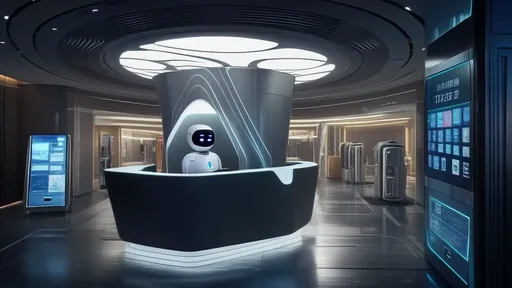
The lobby resembles a scene from science fiction, yet operates with surprising practicality. The primary interface is a humanoid robot with an expressive digital face, flanked by two smaller drone robots that handle luggage. Behind the scenes, a neural network continuously analyzes speech patterns, adjusting responses not just for dialect but for age-appropriate politeness levels. During peak hours, the system can simultaneously manage check-ins in Kansai-ben, Tohoku-ben, and Hakata-ben—a feat impossible for human staff.
Critics initially questioned whether robotic hospitality could ever replicate the subtle art of omotenashi (Japanese customer service philosophy). However, the developers incorporated cultural programming that goes beyond language: the AI bows at precisely 30-degree angles, modulates its "voice" to sound helpful without being overbearing, and even detects guest fatigue through facial recognition to expedite processes when needed. Early reviews praise these touches, with one Okinawan guest marveling at how the robot "spoke like my grandmother."
Beyond the front desk, the hotel employs over 200 specialized robots handling tasks from room cleaning to cocktail mixing. A velociraptor robot in a bellhop uniform checks passports (a whimsical holdover from the original concept), while autonomous trolleys deliver amenities. The rooms themselves feature voice-controlled environments where guests can adjust lighting, temperature, and even window opacity in multiple dialects.
This linguistic breakthrough has unexpected applications. The hotel now serves as a living lab for regional language preservation, with universities collaborating to document rare dialects through guest interactions. Meanwhile, the technology is attracting attention from Japan's tourism board as a potential solution for the nation's acute hospitality labor shortage, exacerbated by its aging population and pandemic-era workforce changes.
Not everything has gone smoothly. Some guests reported initial confusion when the system detected their dialect incorrectly, and the hotel maintains a small human staff for troubleshooting. Energy consumption is another concern—the AI's supercomputers require significant power, though the management offsets this with solar panels and a rainwater recycling system.
As the hospitality industry worldwide grapples with post-pandemic challenges, Osaka's experiment suggests a possible future where technology enhances rather than replaces human connection. The next phase, already in development, will enable the AI to recognize and respond to emotional cues—potentially offering comfort to lonely travelers or alerting staff when medical attention might be needed. For now, watching a grandmother from Kyoto chuckle as a machine commiserates about Osaka's humid summers in perfect Kansai inflection offers a glimpse of how tradition and innovation might coexist.
The Robot Hotel 2.0 doesn't just automate services; it reimagines them through the lens of cultural identity. In a nation where regional pride runs deep, this might be the first instance of artificial intelligence not just speaking a language, but speaking it with a hometown soul. As one guest from Hokkaido put it: "When it said 'Welcome back' in my dialect, I forgot I was talking to a machine. That's the magic."

By /Aug 6, 2025
By /Aug 6, 2025

By /Aug 6, 2025
By /Aug 6, 2025

By /Aug 6, 2025

By /Aug 6, 2025
By /Aug 6, 2025

By /Aug 6, 2025

By /Aug 6, 2025
By /Aug 6, 2025
By /Aug 4, 2025

By /Aug 4, 2025

By /Aug 4, 2025

By /Aug 4, 2025

By /Aug 4, 2025
By /Aug 4, 2025

By /Aug 4, 2025
By /Aug 4, 2025

By /Aug 4, 2025

By /Aug 4, 2025